By Ernesto Negron – Director of Security
Data security is critical in today’s digital world, especially for law firms that handle sensitive client information. A lack of cybersecurity efforts can lead to data breaches, resulting in financial losses, reputational damage and even safety risks for you and your clients. However, as lawyers, your expertise lies in the law, not IT systems.
Managed IT services can bridge the knowledge and skill gap by offering advanced technologies, 24/7 monitoring services, compliance solutions and expert support. Frontline Managed Services explains the details in this article.
What Security Threats Target Legal Practices?
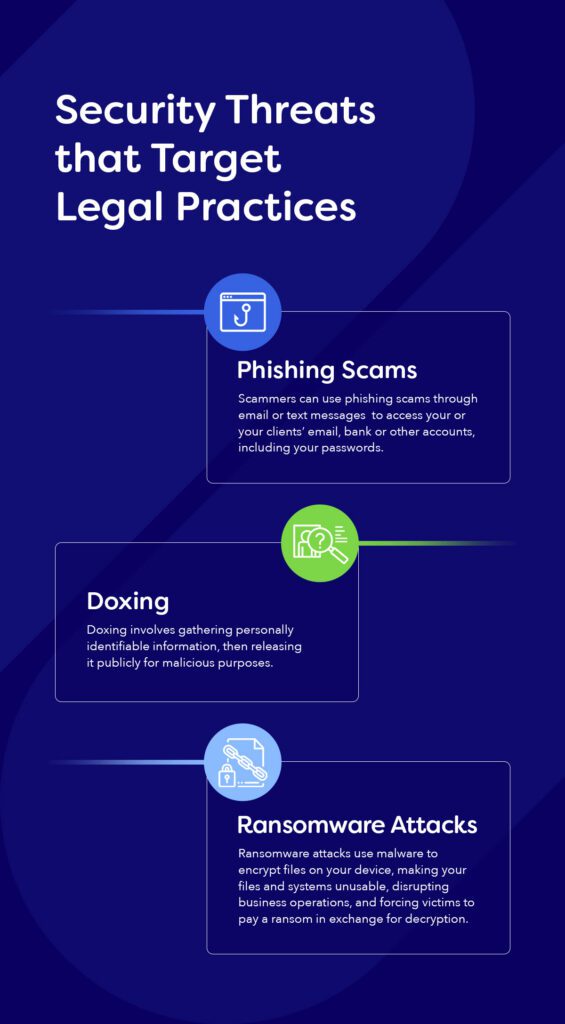
Your law firm is susceptible to social engineering attacks as long as you work with sensitive and valuable information. Social engineering attacks involve psychologically manipulating people into providing confidential information by performing specific actions. Scammers may aim to disrupt your operations, gain unauthorized access or commit fraud. With the rise in technological advancements, the techniques involved in these threats are also evolving.
In 2024, 42% of organizations reported experiencing social engineering attacks. Some attacks you need to be mindful of include:
- Phishing scams: Scammers can use phishing scams through email or text messages to access your or your clients’ email, bank or other accounts, including your passwords. They can sell this information to other scammers or steal your identity, which can cause financial losses and reputational damage. Spear phishing can be especially dangerous, as it is a targeted and researched form of attack. It involves impersonating contacts you may know through fake accounts. According to the Federal Trade Commission (FTC), scammers perform thousands of phishing attacks daily, which are often successful.
- Doxing: Doxing involves gathering personally identifiable information, then releasing it publicly for malicious purposes. This can cause identity theft, stalking, public humiliation or harassment. This attack can also impact you or your clients’ families and neighbors.
- Ransomware attacks: Ransomware attacks use malware to encrypt files on your device. This encryption makes your files and systems unusable, which impacts your business operations. Scammers demand ransom in exchange for decryption. They may threaten to sell or leak your data, otherwise. In 2025, 72% of organizations reported an increase in cyber risks, with ransomware as their top concern.
Apart from digital attacks, you should also be wary of physical ones. For instance, a scammer may impersonate an IT support representative in person, before inserting a device into your computer to steal sensitive information. They then use this information to extort you or your clients.
Why Cybersecurity Is Critical for Law Firms
Managing cyber threats and preventing data breaches is part of your professional responsibility as lawyers. You handle sensitive information daily, whether through document collaboration, e-signing contracts, legal research or workflow automation. These activities make you an attractive target for hackers. Taking safety precautions is especially essential for a remote and hybrid workforce.
The American Bar Association (ABA)’s Model Rules of Professional Conduct indicate you should take reasonable steps to protect client information. Specific model rules that apply to cybersecurity include:
- Competence: As lawyers, you must be competent enough to provide client representation. You need to have the legal knowledge, skill, thoroughness and preparation that’s reasonably necessary. This competence encompasses the ability to handle technology and manage client information that is susceptible to cybersecurity threats. Opting for managed IT services delegates IT tasks to experts who know about them.
- Safeguarding property: You must properly safeguard client properties you possess, including accounts you manage on their behalf. For instance, if you’re managing their trust accounts, you need to take necessary steps to protect them.
- Communication: You must inform clients of circumstances that impact their decisions regarding your representation. You may explain the security measures you have in place that protect client information. You’d also need to notify them of any data breach that involved their information.
- Confidentiality of information: You must not reveal information regarding client representation, unless the client offered their consent, your contract impliedly authorized the disclosure to let you perform your work or if you believe that revealing the information is necessary. This confidentiality goes beyond confidential communications and privileged information. It requires you to make reasonable efforts to protect all information regarding your client representation.
States may also have their own professional conduct rules, often based on these Model Rules. As law professionals, you must stay on top of these data protection requirements. If you’re an international law firm, you must also understand privacy laws in other countries. A globally managed IT service can help you out.
How Do Managed IT Services Protect Client Data?
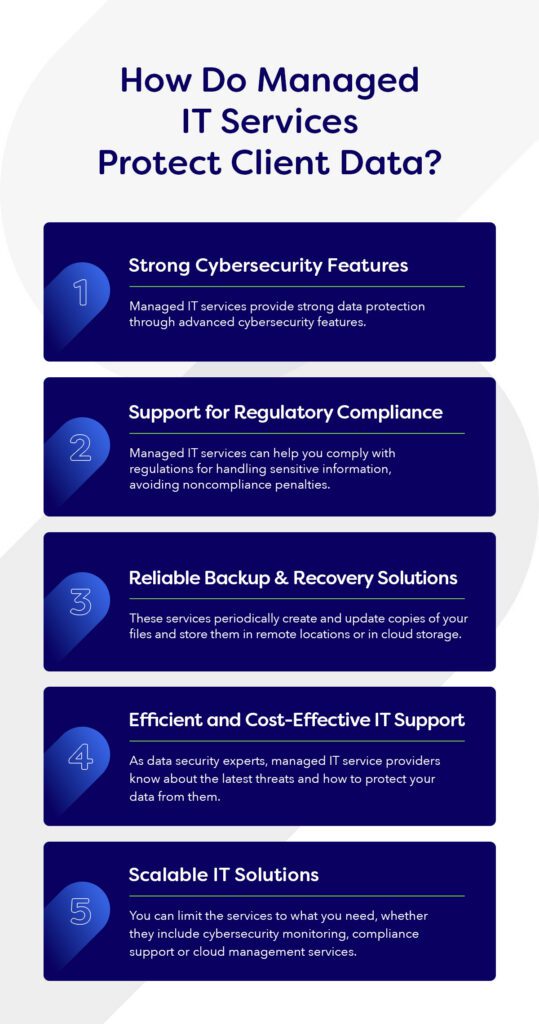
Managed IT services can help protect your client data through the services they offer, which can include:
1. Strong Cybersecurity Features
Managed IT services provide strong data protection through advanced cybersecurity features. They offer security assessments to identify your vulnerabilities and highlight areas for improvement. They also monitor your systems 24/7, detecting and responding to issues immediately before the damage escalates. Since scammers don’t function on a regular schedule, continuous monitoring is essential.
Expert teams use technology that detects patterns of potential attacks from real-time data. Once they identify unusual activity in your system, automated alerts can inform responsible teams of potential breaches. Analytics also examines past incidents to foresee future vulnerabilities. IT teams can then refine security protocols as needed.
2. Support for Regulatory Compliance
Managed IT services can help you comply with regulations for handling sensitive information, avoiding noncompliance penalties. They also provide recovery solutions in the event of a data breach. For instance, you may be handling medical records due to personal injury or medical malpractice cases. In this case, you must comply with the Health Insurance Portability and Accountability Act (HIPAA).
HIPAA requires you to protect people’s identifiable health information, whether electronically, orally or on paper, which includes:
- Past, present or future mental or physical health conditions.
- Past, present or future health care payments.
- Health care provisions.
If your law firm engages in financial activities, such as financial advisory, tax preparation or real estate services, the FTC Safeguards Rule also requires you to keep customer information secure. After a data breach, the FTC suggests that you:
- Secure your systems and fix vulnerabilities immediately.
- Mobilize a response team to prevent further data loss.
- Take all affected equipment offline.
- Determine the legal requirements, including state-specific regulations, for data breach notifications.
HIPAA’s Breach Notification Rule requires you to notify affected individuals within 60 days. A resolution agreement may also apply, where you must perform specific obligations and report to the Department of Health and Human Services (HHS) for about three years. The HHS will monitor your compliance within this period. Data from managed IT services can help you easily comply with the reporting requirements.
3. Reliable Backup and Recovery Solutions
Adhering to regulations involves adopting recovery solutions. However, recovery solutions are only effective with sufficient backups. Managed IT services regularly back up your files and systems to ensure business continuity and minimize downtime. These services periodically create and update copies of your files and store them in remote locations or in cloud storage.
IT services encrypt and regularly test these backups, ensuring they’re free from data corruption. With backups in place, recovery solutions can use the copies to reestablish access to your files, applications, data or other resources. Without these systems, retrieving lost data can take hours or days, impeding business operations. These consequences can be severe, especially if they involve lost, altered or compromised evidence in legal cases.
4. Efficient and Cost-Effective IT Support
As data security experts, managed IT service providers know about the latest threats and how to protect your data from them. This expertise was built throughout their years of experience, which can be proven by their track record. Accessing this expertise can be more cost-effective than building an in-house team. You’ll also avoid the costs of investing in your own equipment.
Some managed IT services leverage automation and artificial intelligence (AI). For instance, a provider may use an AI-powered service desk to make workflow efficient and reduce resolution periods. As experts, they can also provide support for your in-house teams, if you have any. They can offer employee training and share best practices in handling cybersecurity risks.
The cost of lost time and resources due to potential data breaches can be substantial. Long-term costs also include reputational damage and strained attorney-client relationships. With this in mind, investing in an expert IT team can be worth it. They can fill the skill gap in your company without increasing your capital expenses.
5. Scalable IT Solutions
Small to medium-sized law firms can especially benefit from outsourcing IT management. You can limit the services to what you need, whether they include cybersecurity monitoring, compliance support or cloud management services. Growing and established firms also benefit from tailored services, no matter the complexity of their infrastructure. Managed IT services have the capacity to scale:
- Service: You might have fluctuating demand or upcoming growth initiatives. Service providers can have the flexibility to scale their services, adding or reducing resources and support based on what you need.
- Software: Platforms, applications and systems must be able to handle your growing datasets and transactions without impacting functionality and performance. Trusted providers can deliver a streamlined experience thanks to their advanced technologies.
- Infrastructure: The larger your firm, the more you may need to invest in servers, storage and networking equipment. Increasing workloads and demands require more resources. With managed IT services, accessing this infrastructure becomes easier. You won’t even need to allocate physical locations to make room for this infrastructure.
How to Select the Right Service Provider
Some managed IT services are better than others. You might even encounter malicious actors posing as IT experts. To ensure you’re selecting a trusted and reliable provider, look for:
- Proven track record: Look for a history of success and positive client feedback. If you need the provider to support your growth initiatives, do they have the necessary expertise? How many clients have they worked with, and what is the retention rate? Be wary of in-person social engineering tactics, where malicious actors ask for access to your computers. It’s safer to work with established companies with decades of experience.
- Certifications: Certifications ensure providers have the training and skills necessary to protect your sensitive information. The staff should also be certified depending on their focus area, whether it’s cyber defense, cloud security or digital forensics. Certifications indicate whether professionals, such as an accounting or auditing firm, have reviewed the provider’s processes to ensure they operate effectively. As a company, a provider can have different certifications, such as ISO/IEC 27001 and Service Organization Control (SOC) 2 certification.
- Comprehensive and personalized services: Each law firm has its own needs and challenges. One firm might handle medical cases, while another focuses on tax law. Does the provider show valuable insights and possess a deep understanding of your industry? What is included in the managed IT support services? A tailored solution is essential in achieving your long-term goals.
- Advanced technological solutions: Although many IT services leverage advanced technology, some use better technologies than others. How can the provider’s technology scale with your business? Will they be able to adapt to your workload? Do they have proprietary technology that makes workflow more efficient?
- Quality and level of support: Support schedule is important in case of data breaches. Will you be able to contact them 24/7 throughout the year? Do they have a clear process in case of incidents? How can they help you comply with regulations, especially regarding incidents?
Protect Your Law Firm Through Managed IT Services
As law professionals, it’s your responsibility to ensure your clients’ information is well-protected. Managed IT services play a significant role, as they can help you navigate the increasing cyber risks that come with advancing technology. These services also protect you and your company, ensuring malicious actors can’t steal your information and identity. Given the consequences of data breaches, investing in managed IT services can be worth the cost.
Depending on the provider, covered services can include:
- Strong cybersecurity features.
- Support for regulatory compliance.
- Backup and recovery solutions.
- Expert training.
- Scalable growth solutions.
However, some providers are better than others. Consider working with those who have extensive industry expertise. Certifications and a proven track record also show if you’re looking at a trusted company. Tailored professional services ensure you’re getting the solutions you need.