The most common IT challenges facing law firms today include defending against sophisticated cyberattacks, protecting data across cloud and vendor platforms, managing technical debt, minimizing downtime, supporting complex legal applications, governing artificial intelligence and aligning technology investments with firm priorities.
These are no longer concerns for the IT department alone. They affect attorney productivity, client service, profitability, business continuity and the firm’s ability to grow.
Technology is now woven into nearly every aspect of legal work. When it performs well, attorneys may barely notice it. When it does not, the effects quickly show up in lost time, frustrated users, delayed client work and unplanned costs.
The professional responsibilities surrounding competence, confidentiality, supervision and client protection also remain in place as firms adopt new platforms and AI tools. The technology may change. The firm’s responsibility for how it is selected, governed and used does not.
1. Defending Against More Sophisticated Cybersecurity Threats
Law firms hold exactly the kind of information attackers want: privileged communications, financial information, litigation strategies, intellectual property and sensitive client data.
The threat is also becoming more difficult to recognize. Cybercriminals are not relying only on malicious attachments or obvious phishing emails. They increasingly impersonate trusted people, use legitimate remote-access tools and exploit everyday business processes.
In May 2026, the FBI warned that a cybercriminal group was specifically targeting U.S. law firms by posing as IT personnel through phone calls and phishing emails. Attackers attempted to persuade employees to grant remote access and, in some cases, sent individuals to offices to gain physical access to computers.
That is why cybersecurity cannot be reduced to a list of tools. Firms also need strong processes for verifying identities, controlling administrative access, approving remote connections and responding when something does not look right.
Leadership should understand:
- How identities are verified before credentials or access rights are changed
- Who has privileged access to critical systems and data
- Whether unusual sign-ins, downloads and administrative changes can be detected
- How employees are expected to verify requests from IT personnel
- Whether the firm has practiced its response to a meaningful cyber incident
The goal is not to choose between security and productivity. It is to build controls that protect the firm without making legal work unnecessarily difficult.
2. Managing Data Security Across Cloud and Vendor Platforms
Law firms increasingly depend on cloud platforms and third-party providers for document management, collaboration, billing, research, file sharing and other critical operations.
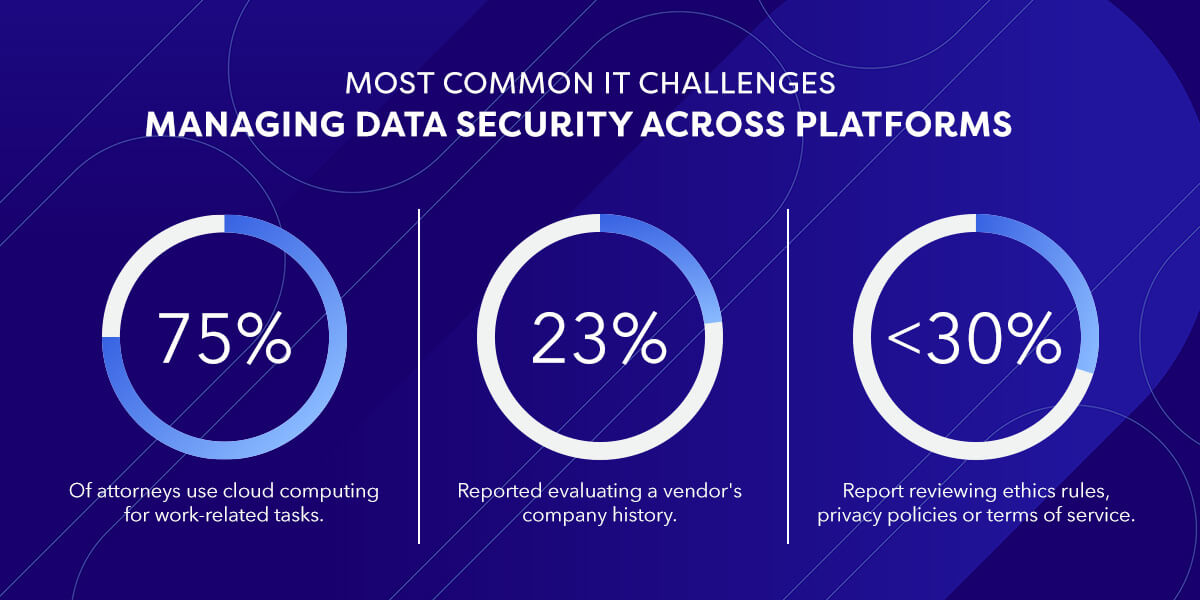
According to ILTA’s 2025 Technology Survey, which included responses from 580 firms, 88% said they were either mostly in the cloud or moving to the cloud with each technology upgrade.
Cloud adoption can improve flexibility, availability and collaboration. It also creates a broader network of providers, integrations and access points that the firm must govern.
Before adopting a platform, firms should understand:
- What information the provider can access
- Where the data will be stored and processed
- How users, administrators and vendors are authenticated
- Whether information is encrypted
- Which subcontractors or fourth parties are involved
- How quickly the firm will be notified of a security incident
- Whether the platform can satisfy client security requirements
- How data will be returned or destroyed when the relationship ends
The review should not stop after the contract is signed. Vendor ownership, product architecture, subprocessors, data practices and security controls can change over time.
Moving data to the cloud does not move accountability away from the firm. Good cloud strategy requires ongoing governance, clear ownership and enough visibility to know where sensitive information is and who can reach it.
3. Managing Technical Debt Before It Limits the Firm
Technical debt builds when firms postpone upgrades, continue using unsupported systems or rely on temporary fixes that eventually become permanent.
It may take the form of aging workstations, inconsistent configurations, legacy applications, manual processes, fragile integrations or infrastructure that is becoming increasingly difficult to secure and maintain.
Technical debt is not necessarily evidence of poor management. Even mature firms defer projects because of budget limitations, competing initiatives or the risk of disrupting active legal work.
The difference is whether those decisions are deliberate.
A mature firm knows where its technical debt exists, understands the business risk and has a plan for addressing it. A less mature firm discovers the problem when something fails.
A multi-year technology roadmap helps leadership:
- Sequence major investments
- Spread costs across budget periods
- Coordinate upgrades with business priorities
- Reduce emergency spending
- Improve consistency and stability
- Prepare for growth, office changes and new applications
The oldest technology is not automatically the highest priority. A billing-system weakness, client security requirement or recurring productivity issue may deserve attention before an aging asset that is still performing reliably.
Priorities should be based on business impact, not simply on the age of the technology.
4. Reducing Downtime and Protecting Attorney Productivity
Downtime rarely arrives as a dramatic firmwide outage. More often, it appears as slow applications, recurring login problems, unreliable remote access, failed integrations or repeated interruptions that take a few minutes at a time.
Those minutes add up.
For a law firm, poor technology performance can delay client responses, interrupt billable work, slow billing and collections and frustrate attorneys and staff. The cost is not limited to the technology needed to fix the problem. It includes the productive capacity the firm loses while the issue persists.
Leadership can begin estimating that exposure with a simple calculation:
Number of affected timekeepers × average billing rate × length of disruption
Downtime does not always appear as a firmwide outage. More often, it shows up as slow applications, recurring login problems, unreliable remote access, failed integrations or repeated interruptions that take attorneys and staff away from their work.
Over time, those disruptions can delay client responses, interrupt billable activity, slow billing and collections and reduce confidence in the firm’s technology environment.
Leadership should look beyond individual incidents and monitor broader patterns, including total downtime, application availability, recurring issues, resolution times and user satisfaction.
A decline in repeat problems can indicate that roadmap investments and root-cause analysis are working. The goal is not simply to restore operations after an interruption, but to reduce the likelihood that the same problems return.
5. Supporting Complex Legal Applications and Workflows
Law firms do not run on general business software alone. They depend on specialized systems for document management, time entry, billing, financial management, practice management, litigation support, research and client collaboration.
Those systems must work together. They also need to operate within the firm’s Microsoft environment, identity architecture, security controls, devices and data-governance policies.
That complexity makes legal application expertise important.
A document-management problem may prevent an attorney from reaching critical matter information. A billing-system issue may delay invoices or collections. A poorly planned upgrade may break an integration that several departments rely on.
Resolving those problems requires more than knowledge of the application itself. It requires an understanding of the legal and business workflow surrounding it.
Effective application management includes coordinating vendors, managing upgrades, maintaining integrations, documenting dependencies and prioritizing issues according to their effect on attorneys, clients and financial operations.
The underlying question should always be: What part of the firm’s work is being affected, and how quickly does it need to be restored or improved?
6. Adopting Artificial Intelligence With the Right Strategy and Governance
AI adoption is moving faster than many firms’ ability to govern it.
According to recent research, 79% of legal professionals use AI in some capacity, while only 22% of firms have a visible AI strategy. This gap creates risks around data privacy, inconsistent use, shadow AI and unclear accountability.
A practical AI strategy should address:
- Approved tools and use cases
- Data security and vendor practices
- Human review requirements
- Attorney and staff training
- Integration with existing systems
- Measures of productivity and business value
The strongest AI strategies begin with the business problem, not the technology. Firms should focus on use cases that improve workflows, reduce administrative effort and strengthen client service.
AI should be treated as a business transformation initiative, supported by clear governance, training and measurable objectives.
7. Aligning IT Investment With Firm Strategy
Many technology conversations still begin with one question: “How much will this cost?”
Cost matters. But it is only one part of the decision.
Firm leadership should also ask:
- Will this reduce disruption or risk?
- Will it make attorneys and staff more productive?
- Will it improve client service?
- Will it make spending more predictable?
- Will it support growth or a new business priority?
- How will the firm know whether the investment worked?
Firms that manage technology reactively often face recurring problems, inconsistent experiences and unplanned spending. Firms with a more mature approach connect technology decisions to business outcomes and plan investments before an urgent event forces the decision.
This requires partnership across leadership roles.
CIOs and IT directors need to explain recommendations in terms of risk, productivity, financial impact and client expectations. CFOs and COOs need visibility into future costs, dependencies and operational effects. Managing partners need enough business context to sponsor the investments that matter most.
Governance should help those decisions move forward. When it creates unnecessary layers, isolates projects or leaves priorities without executive ownership, it becomes another source of delay.
How Can Law Firms Address These IT Challenges?
Law firms can address these challenges by assessing where technology is creating the greatest risk or disruption and developing a multi-year IT roadmap aligned with the firm’s business priorities and budget. The roadmap should address cybersecurity, technical debt, cloud and vendor governance, legal applications and emerging technologies such as AI.
A proactive approach helps firms protect client information, reduce downtime, improve attorney productivity and make technology spending more predictable.
Frontline Managed IT Services helps law firms evaluate their technology environments, prioritize high-impact improvements and build practical strategies for stronger performance. Contact us today to start optimizing your law firm’s IT operations.